How To Categorize Your Marketing Metrics

When selecting the right metrics to measure your marketing and communications activity, it's good practice to use a framework that helps guide you toward better measurement.
I’ve developed my own measurement framework that you can access on Miro. If you’re not familiar with Miro, it’s a visual planning and collaboration tool, and you can register an account for free (free accounts allow you to create up to three board).
My marketing metrics framework template is available as an approved template in the Miroverse, which is Miro’s community of the top creator templates. You can access and clone the template using the link below.
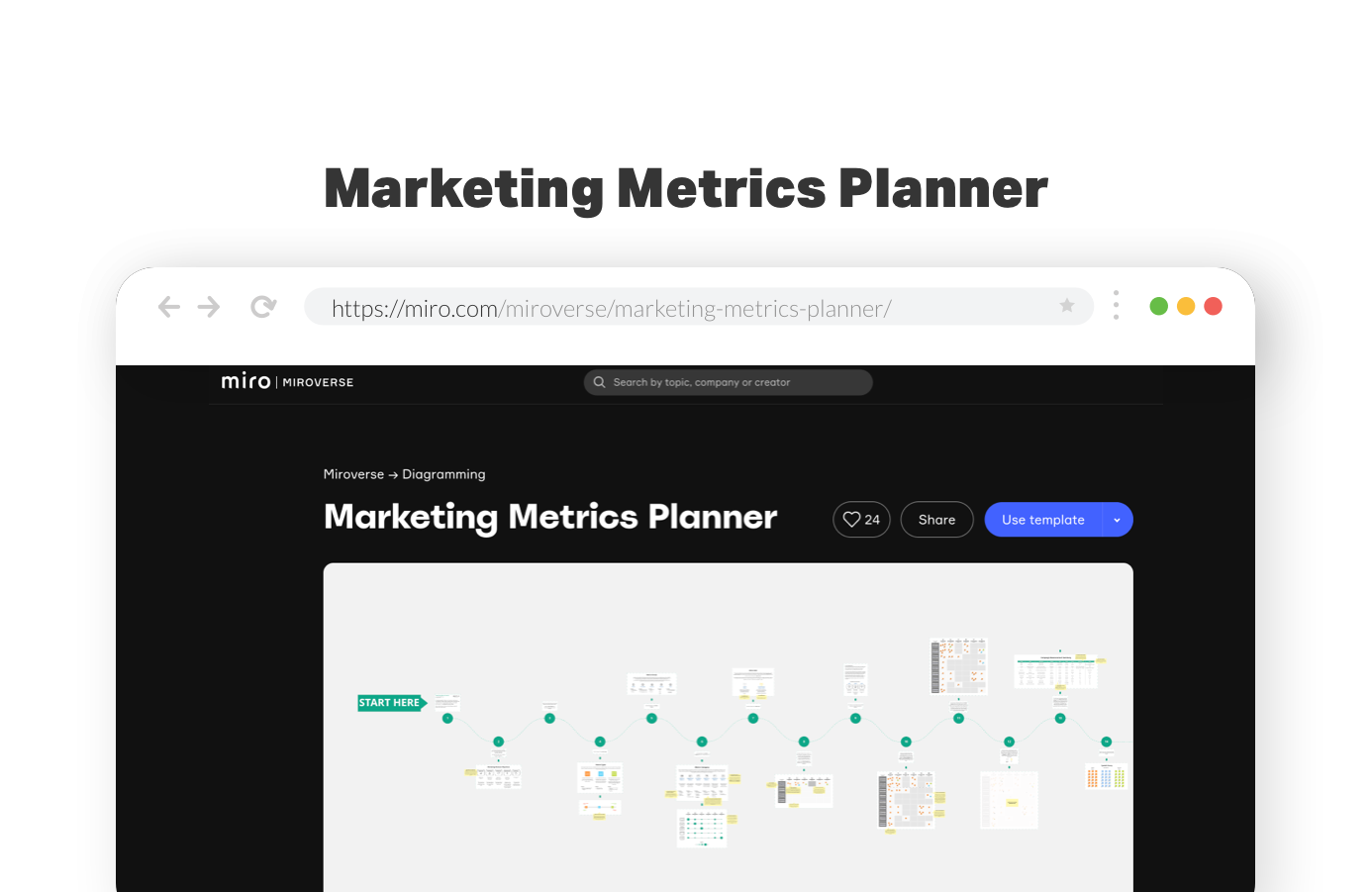
In this post I want to go deeper into one of the key aspects of metrics selection you will encounter in my measurement framework, which is where you categorize your metrics in terms of their purpose.
Overall, there are six metric categories which include awareness, engagement, perception, experience, acquisition and conversion.
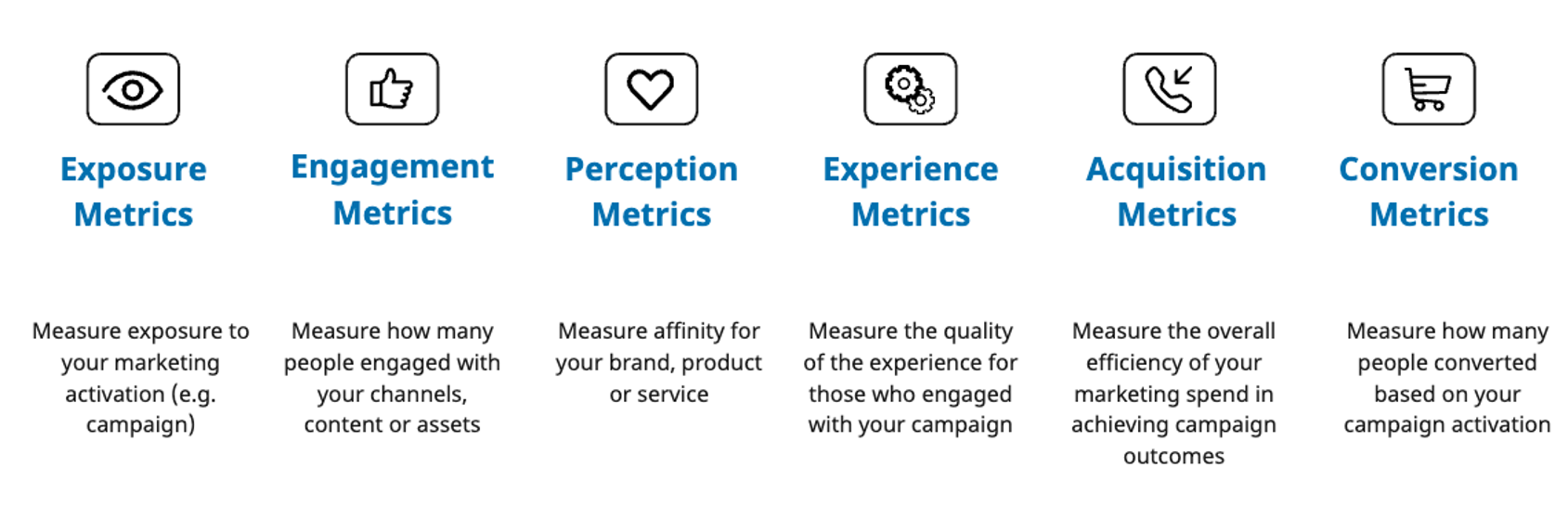
It's important to note that depending on your campaign objectives and channel mix you may not need a metric that falls into each category. But I generally recommend that you select metrics that fall into at least three of the six categories so you don't run the risk of focusing on one measure in isolation. This is what I like to call anchoring, which means that you're always looking at one metric or KPI relative to another.
For example, let’s say you’re running a campaign, and the objective is to drive awareness for a new product you just launched. And as part of this campaign, you’re using Facebook and Twitter promoted-posts to drive traffic to a custom product landing page on your website. In scenarios like this, I’ve seen marketers go all in on exposure metrics like ad impressions or reach. The problem is these metrics are bought, not earned. So if you report back to your boss and say our campaign achieved 1 million impressions, I would say, “so what!”.
But if we look at impressions next to another metric, like the bounce rate on the website landing page or average time on page, then you start to see the bigger picture. For example, 1 million impressions wouldn’t look so great if we found out that the average bounce rate on the landing page was 98% or the average time on page was 3 seconds.
So always try to anchor metrics to others so you can see the full story and learn from it.
Great, now let’s look at the six individual metric categories.
Exposure Metrics
Exposure metrics measure how many people you reached as part of your campaign.
Example metrics:
Website users or sessions
YouTube Subscribers
Ad impressions
Facebook Reach
News Coverage / clippings (PR)
Benefits of Exposure Metrics
Exposure metrics are easy to understand and generally very easy to retrieve. And they’re typically essential to getting a full picture of performance, as you will usually anchor performance of metrics like engagement or conversion to exposure metrics.
Limitations of Exposure Metrics
Exposure metrics are often misused for vanity purposes as they often produce the biggest and most impressive number. This is why you should never look at exposure metrics in isolation, as they should always be considered in relation to metrics in other categories such as engagement or conversion.
Engagement Metrics
Engagement metrics measure how many people interacted with, responded to or engaged with your channels, content or assets.
Example Metrics:
Website bounce taye
Average time on page / screen (website or app)
Clicks / Clickthrough Rate
Likes, Comments or Shares
Engagement rate
Benefits of Engagement Metrics
Engagement metrics provide powerful insight into how well your marketing activity performed (e.g. did your content resonate with the target audience). This type of metric is also very useful when examined in relation to metric categories like exposure and perception. For example, did engagement on my website (say average time on page) go up because of a significant increase in traffic volume?
Limitations of Engagement Metrics
Contrary to what many believe, seeing improvement in your engagement metrics is not always a good sign. For example, you could receive high engagement due to a negative story about your brand that has gone viral. Let’s consider Samsung’s exploding battery crisis with the Note 7. When news of the issue started to go viral, engagement on Samsung’s social channels, like Facebook, probably shot through the roof. But not for the right reasons, as the Samsung social media and PR teams we’re likely working round the clock to deal with the crisis.
So you have to be wary of the pitfalls of assuming engagement is always a good thing.
Another limitation of engagement metrics is that acquiring rate-of-engagement metrics, which are often the most valuable, can be hard to come by. The purest form of this is an engagement rate where you divide the number of people who engaged out of the number of people who saw the content. The problem is many social networks don’t natively support engagement rates these days, and not all of them give you the data you need to calculate it yourself.
Facebook, for example, supported native engagement rate in their legacy Page Insights tool, but this metric seems to be gone in their latest overhauled analytics tool, as they focus more on volume metrics like counting likes and shares.
Perception Metrics
Perception metrics provide insight into the tone, sentiment or opinion toward your marketing activity, product or brand. In short, they measure affinity for your brand, product or services. Measuring engagement is not always enough, and perception metrics can fill a big gap in terms of helping you understand whether your activation has positively impacted consumer or customer perception toward your brand, products or industry.
Example metrics:
Comment Sentiment
Likes, Dislikes
Like:Dislike Ratio
Benefits of Perception Metrics
Perception metrics like sentiment, if quantified properly, offer rich insight into your target audiences’ response to your marketing activity. Tracking perception can help answer critical questions such as did people like your campaign or hate it, or did your campaign increase or decrease brand affinity.
Limitations of Perceptions Metrics
Unfortunately, perception metrics can be the most difficult to acquire. Comment sentiment is one example of a metric that can fall within this category. But what is comment sentiment? Well, you could look at it in terms of a net sentiment score (which scores content based on the tone be positive, neutral or negative) or simply use the percentage of comments that are positive. Either way, the challenge will be tagging your content as being positive, neutral or negative. There are tools and python data science models that can do this to varying degrees of accuracy. But either you could end up needing a lot of many to throw at an expensive tool, or a data scientist to help crack this for you. Alternatively, you can have someone tag sentiment manually, but that can be painful.
The good news is that some measures of perception are easier to come by than others. For example, some types of engagement on social media explicitly denote the sentiment. A like on a post, for example, is a good proxy for affinity.
Experience Metrics
Experience metrics measure the quality of the experience for those who engaged with content on your owned channels. This type of metric only applies to (and will only be available on) platforms where you have direct access to 1st party data (e.g. Google Analytics for an app or website you operate).
Experience metrics help diagnose potential issues (e.g. broken web pages, long page load times, etc.) that could affect campaign performance. Simply put, they help you ensure that poor campaign performance isn't the result of some technical issue. That being said, although experience metrics are good to track, they shouldn't be a KPI for a marketing campaign.
Example Metrics:
Average site / page load time
Crash rate
4xx errors (e.g. 404 error, etc)
Benefits of Experience Metrics
Experience metrics offer insight into the root cause of a poor-performing campaign that you might otherwise attribute to something else (e.g. creative assets, ad targeting, etc).
As an example, let's say you have a large-scale display campaign driving traffic to a landing page on your site, and you notice that 95% of the visitors bounce when they should be viewing multiple pages. When you see under performance such as this, your first instinct might be to blame the ad creative or execution (e.g. copy, creative, targeting) and diagnose whether there's something wrong with your media plan. But what if you looked at Google Analytics and found that average page load times on your site were five minutes! In this case, most visitors were probably bouncing out of frustration due to long load times.
This is why you should look at experience metrics for the platforms you manage. Experience metrics help you to properly diagnose poor-performing campaign assets so you don't waste time trying to optimize something that isn't broken.
Limitations of Experience Metrics
Diagnosing technical issues or errors that are the root cause of a poor user experience can be a difficult and cumbersome task. You will also sometimes be constrained by existing technological platforms and architectures that can make it difficult to react to performance-related issues. So there will be limits to what a marketing team can actually monitor here. My suggestion is to focus on key measures, such as page/screen load times and error or crash rates. Anything beyond that and you may want to shift the responsibility to your web or app ops team.
Acquisition Metrics
Acquisition metrics measure the overall efficiency of your marketing spend in achieving your campaign goals. These are the typical ‘cost-per’ metrics you’ve probably seen or heard before, such as Cost Per Click, and Cost Per Impression. They’re calculated by dividing the total cost of your interactions (e.g. clicks, leads, etc) by the total number of interactions. For example, if you spent $500 on ads, and generated a total of 1000 clicks, then CPC is $0.5.
Example Metrics:
Cost Per Click (CPC)
Cost Per Impression (CPM)
Cost Per Lead (CPL)
Cost Per Outcome (CPO)
Benefits of Acquisition Metrics
I often refer to acquisition metrics, like CPC, as the cost-of-doing-business metrics. This is because these metrics tell you, very directly, about spend efficiency. For example, if you know that your benchmark for CPC is $0.5 from your prior campaigns, but your latest campaign is running at a CPC of $1.5, you know that either something is wrong with your ad creative, ads configuration, or that you’re simply targeting a more difficult niche. Either way, it only takes 1 second to look at an Acquisition metric to know that something may be wrong and that you need to take action.
Limitations of Acquisition Metrics
I sometimes see acquisition metrics being conflated with conversion or ROI. Let me be clear, they are not. If your boss asked you what the return on investment for your campaign was, you wouldn’t respond by telling them how much you spent. So never use measures like CPC, CPM or CPL as conversion or ROI metrics. These metrics simply tell you about the efficiency of your marketing dollars, nothing more, nothing less.
Conversion Metrics
Conversion metrics tell you how many people followed through to a desired action (or actions) which in turn creates some form of business value. Conversion metrics are most often associated with e-commerce and sales. However, conversion metrics apply to any channel and business objective and can include metrics like leads, whitepaper downloads, etc. Simply put, conversion metrics measure any action(s) that you intended your audience to take as a result of being exposed to your marketing activity.
Example Metrics:
Sales
Transactions
Conversion Events / Goals
Conversion Rate
Benefits of Conversion Metrics
Conversion metrics are essential to understanding whether your marketing activity is actually creating business value.
Limitations of Conversion Metrics
Outside of e-commerce, you need to be very careful about how you select and quantify your conversion metrics. Make sure that you choose metrics/actions that truly create some form of business value. And if you do decide to use a conversion rate make sure you consider which touch points contribute to your conversion calculation (e.g. site-wide visits vs landing page visits / sales).