Facebook Analytics is Dead, Here's Why You Should Care

Header image by @solenfeyissa via Unsplash
Back in April Facebook quietly announced the death of its cross-platform measurement tool, Facebook Analytics, which is going away for good later this month.
Before you freak out, you should know that this has nothing to do with the data you get from tools like Page Insights or Business Suite Insights, as these will live on. In fact, you’ve probably never even heard of or used Facebook Analytics, and that’s exactly why this news should annoy you. Measurement of branded content on Facebook today is a mess, and Facebook Analytics, though not perfect, was an important step toward Facebook giving businesses more control, clarity and flexibility around how they make sense of their data. But despite the tool having strong potential as a singular dashboard for marketers to use for all their FB measurement needs, it was slow to evolve and frustratingly under-promoted over the years.
But before I go on, let’s take a step back.
What is Facebook Analytics
Facebook Analytics is a standalone tool for cross-platform measurement and analysis that launched several years ago. It allowed you to aggregate, filter, visualize and analyze data from multiple sources, such as a Facebook Page, Instagram Page, a mobile app running Facebook’s SDK, or even off-platform data collected via Facebook’s tracking pixel.

Facebook Analytics - Overview screen
Aside from cross-device / cross-platform measurement, there were some pretty cool things you could do with FB Analytics. For one, you could create custom dashboards and interfaces, giving you more control over what data you see and how. This is a gripe I’ve always had with other FB data tools, such as Page Insights, which are stifling because of how inflexible they are.
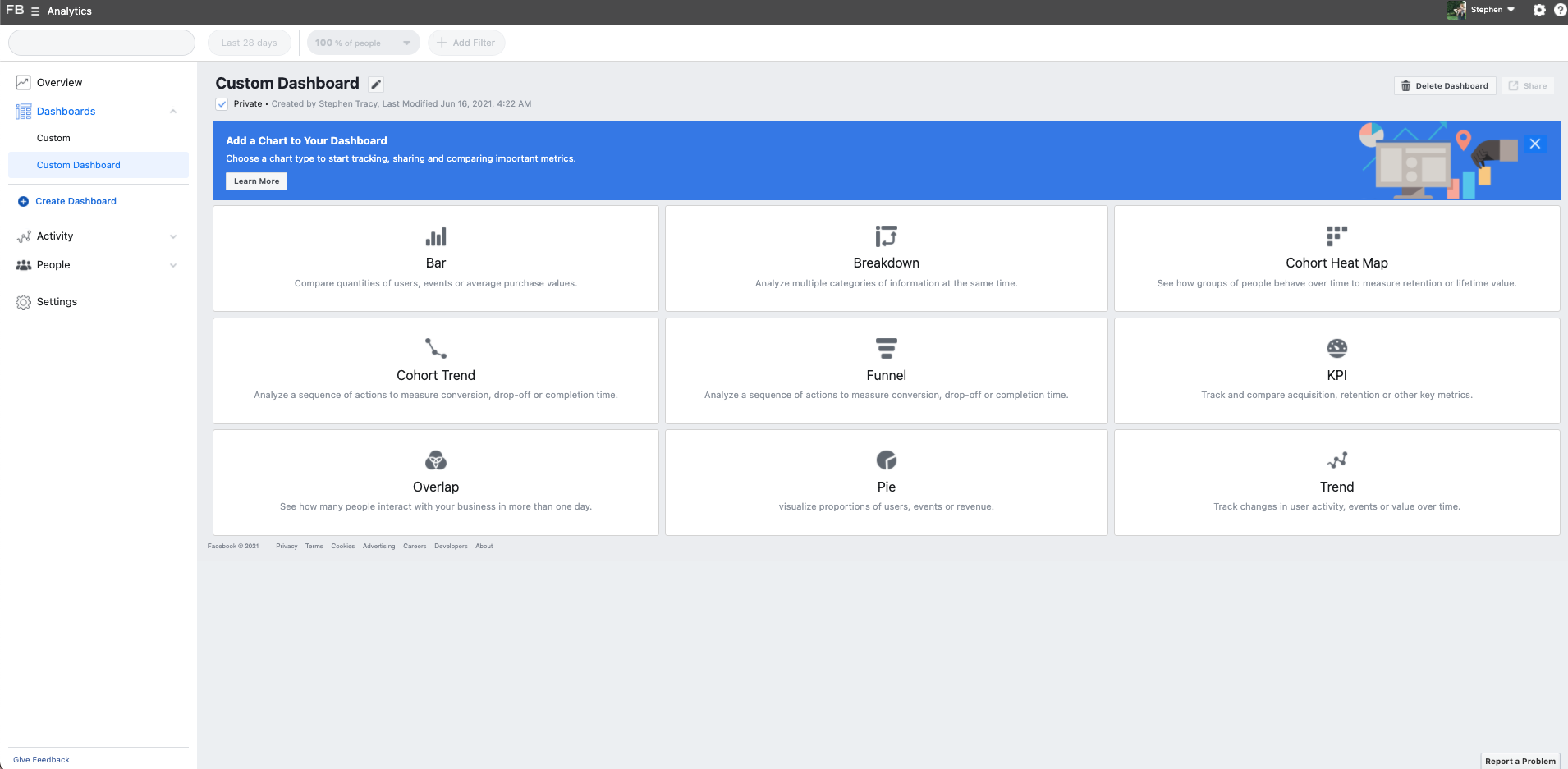
Facebook Analytics - Create custom dashboards
Beyond custom dashboards, FB analytics allowed you to aggregate data across various sources, including transactional data synchronized through tracking cookies. This meant you could use FB Analytics to get pretty in-depth data and insight around how your content and FB ad spending actually performed, both on and off the social network.
FB Analytics even offered a dedicated mobile app that featured fully tactile and interactive charts, which is something I’m a big fan of (i.e. mobile analytics).
So why should you care?
FB Analytics is far from perfect. Its UI has always been a bit clunky, speed and performance could feel sluggish at times, and enhancements to the tool over the years were sparse. But the creation of FB Analytics suggested that the company might just be committed to finally building a “Google Analytics” for Facebook. Something that has been long overdue and much needed.
The truth is, Facebook has never offered marketers a solid native measurement solution for any of its business solutions. And despite its flaws, FB Analytics was still light years ahead of every other native FB measurement tool in terms of the range of use-cases it serviced as well as the depth of insight one could extract from it.
If you’ve ever been tasked with making sense of your business’s FB data, you’ve probably struggled to make sense of it all at one time or another. I’ve seen this first hand. Over the years I’ve run countless training sessions and workshops on marketing analytics, and whenever the topic of Facebook measurement comes up I can see the pain in my students’ eyes. Even among the more data-savvy and seasoned marketers that I’ve trained, there’s often this sense of bewilderment when the topic of Facebook measurement comes up.
There are plenty of reasons why you might get a little lost when trying to extract and apply your business’ data from Facebook. For one, your page, post and ad data are scattered across a hodgepodge of different native Facebook tools and dashboards. Many of these tools are frustratingly inflexible, giving you little control over how you compare, cut and filter your data. Data exports are also hard to come by for many of the different tools. And even something as basic (yet fundamental) as metric definitions that explain how certain things are quantified are sparse. The latter is something Google Analytics does very well.
To give you an idea of what I mean with respect to how convoluted Facebook’s measurement ecosystem is, I previously created a map that I’ve used to help my students better understand how and where to find data. It’s important to note that with FB Analytics going away as well as some recent changes to the data you can retrieve via Business Manager, this map is already a little outdated.
Facebook’s Measurement Ecosystem
The map above shows the 12 different sources where you can find data related to the content you publish on FB as well as the audience you engage. The circlcular symbols indicate where you can find these tools and data (i.e. whether it’s via your FB Page or Business Manager) while the coloured bars show different data sources (i.e. a Page, a Post, Ads, etc). Finally, I also mapped out, subjectively, the depth of data you can retrieve from each source using 4 levels.
Level 1 - The tool only offers surface-level insight, with no ability to export data and it has an extremely limited UI for filtering, visualizing and analyzing your data.
Level 2 - The tool offers the ability to export your data to Excel, though it still has an inflexible UI for analysis.
Level 3 - The tool offers a slightly more flexible UI for carrying out visualization, filtering and analysis of your data, and data exports are available.
Level 4 - The tool offers greater flexibility, including the ability to export data, aggregate data across sources, create drill-paths within your data, and the ability to create custom dashboards.
So why does the fact that FB Analytics is going away matter? If you look at the map again you’ll see that FB Analytics was the only one among the 12 tools that offered cross-platform measurement and flexible tools for aggregation and analysis that go deep. As I said, FB Analytics wasn’t perfect. Far from it actually. But even with its flaws, it was still the best native data analytics tool Facebook had to offer. And with a clear product vision and perhaps few more years of development I think it could have been something special.
But was it really that good?
The news cycle around FB Analytics shutting down has been light, and limited to a small group of niche outlets covering the update. And for those who did write about it, the general sentiment seems to be, ‘it’s no big deal’. Arguments in favour of FB Analytics shutting down seem to be centered on the fact that Facebook doesn’t really need to offer robust native tools for data analysis, since the market for 3rd party tools that allow you to extract and store FB data has evolved greatly in recent years. And so many marketers or analytics teams are now pulling data out of FB and loading it into their own data stack.
For product managers and organizations with more advanced analytics practices, I fully agree with these sentiments. After all, the more advanced users were probably never that focused on using FB’s native tools anyway.
But for the average marketer, be it a small business owner or even a big brand that doesn’t have access to a sophisticated analytics team, the shutter of FB Analytics signals Facebook’s lack of commitment to building tools that everyday marketers can actually use to make good decisions with their data.
Let’s consider for a moment how we got here.
A time when pay-to-play wasn’t the norm
If you’re someone who has been using Facebook to reach existing and prospective customers for a while, you’ll probably remember a time when you didn’t have to pay to reach people who already liked or followed your business on Facebook.
Back in the good old days things were simple. If you were a business and had products/services to sell, you could create a Facebook Business page, start posting content, build an audience, and occasionally promote your content using Facebook’s ad solutions to reach more eyeballs. But in this model, marketers typically only used Facebook ads to reach the people who weren’t already a fan of their business on Facebook.
Around 2014 that all changed.
Over the course of that year Facebook began to roll out a series of updates to their newsfeed algorithms that resulted in massive drops to organic reach (i.e. the number of Facebook users who are a fan/follower of your page who you reach without promoting a post).
Marketers around the world were outraged as the unfolding reachpocalypse forced many business users to face a stark realization - that they would have to start paying to reach the followers they already acquired, and in some cases even paid to acquire.

But despite the collective outrage, open letters, demands to roll back the changes or even find a middle ground, Facebook stuck to their guns. And as their ad revenue and profits soared, over time marketers slowly accepted the new reality of pay-to-play. Eventually, it just became the norm.
The chart above shows Google search interest for the term “facebook organic reach” over time. That spike happens in February 2015, when some of the FB newsfeed algorithm changes really started to take effect. Over the years, you can see how search interest in “organic reach” simply fades away, as we all got used to the idea of paying to reach anyone and everyone on Facebook. Random side note, remember when Facebook experimented with letting personal accounts pay to promote posts to their friends and family? 🤨
Facebook’s revenue has obviously soared ever since their shift to pay-to-play. And honestly, I don’t really fault them for the decision to kill organic reach. It’s obviously been a lucrative decision for them, and hey, make that money.
What I am annoyed with (and I think you should be too) is that despite how lucrative their ad solutions business has been, they’ve never properly re-invested any of that revenue into analytics tools that empower their business users. Honestly, it’s almost laughable how little Page Insights has changed over the course of 7 years. As a parallel, just look at how other marketing analytics tools / suits, such as Google and Adobe, have evolved over the same period. In fact, since 2014 an entire ecosystem of data analytics providers and solutions have emerged while Facebook’s own data analytics tools have been on autopilot.
FB Analytics, for me, was the first time I saw the company roll out a tool that actually showed Facebook’s commitment to helping marketers make better decisions on their platform using data. Now it’s going away, and with no clear alternative on the horizon.
And despite the hardship that many people and companies have faced over the last 1.5 years as a result of the pandemic, Facebook closed 2020 with another record-setting year, generating more than U$84 billion in revenue. And with the impact on many businesses as a result of Covid-19, it’s more important than ever for businesses both big and small to make smart, evidence-based decisions using their data.
So let’s hope Facebook will consider investing some of those billions into developing native measurement tools that marketers can actually use.
If you enjoyed this article then you’ll love my marketing analytics course. Click the link below for more info.