The Data Job Market in 2026: Why It Feels Harder Than Ever (And What To Do About It)

Is a career in data still worth it?
And if so, why is it so darn hard to land a job in data right now?
These are questions I see come up a lot these days. Through the career coaching work I do, I’ve noticed a growing trend:
data practitioners and recent grads are struggling to land interviews, let alone job offers
And for those who have recently gone through the hiring process, many come out mentally exhausted from the hellscape that is applying and interviewing for data roles right now.
So what’s happening?
It certainly isn’t due to a lack of demand. According to the U.S. Bureau of Labor Statistics, employment for data scientists is projected to grow 34% by 2034, making it one of the fastest-growing occupations in the U.S. economy.
But the market is changing, and multiple factors are contributing to the current job squeeze.
If you’re applying for roles as a data analyst, BI specialist, data scientist, analytics engineer, or AI/ML engineer in 2026, it probably feels harder than ever to land an offer.
In this article, I’ll unpack why the data job market is so tough right now. But before I go any further, I recently launched a FREE course designed to help data scientists, analysts, engineers, and BI specialists better position their skills, build a winning resume and portfolio, and land a data job in 2026. You can enroll on Udemy completely free using the link below.
The Data Job Market in 2026: Healthy, But Unforgiving

Every serious organization now runs on data. Businesses are embedding analytics into operations, marketing, supply chains, and product development.
The demand is real. But here’s what’s changed.
Five years ago, knowing SQL and Python could get you through the door. Today, those skills are table stakes. Employers are looking for more. At the same time, a range of factors are making it harder to get noticed and land a role.
A recent study by Greenhouse found that in 2025, on average, 66% of job seekers spent three months or more looking for a job.
The same report also found that confidence levels were low. In the U.S., only 18% of job seekers reported feeling “very confident” about the job market. Meanwhile, 38% were somewhat confident, and 44% were either not very confident or not confident at all.
So what exactly is creating downward pressure in the job market?
I believe there are four main factors:
Increased supply and industry saturation
Increased sophistication of data operations
Economic rationalization
And of course, the impact of AI and LLMs
Let’s dive into each of these.
1. Industry Saturation
Demand continues to be strong for data roles, and forecasts remain healthy. For example, in the World Economic Forum’s 2025 Future of Jobs Report, data roles made up five of the top fifteen fastest-growing jobs, and even topped the list.
But while demand remains high, there are simply more data professionals than ever before.
Bootcamps. Online certifications. University programs. AI-generated learning paths. The barrier to entry has dropped dramatically.
Just look at Google Trends for “data courses.” Search volume for data-related courses peaked in 2025.
Increased access to education is good for the industry. But it also means employers now see hundreds of CVs that look almost identical.
On top of that, candidates are using generative AI tools to optimize and tailor their resumes to specific roles. There’s nothing inherently wrong with that. However, in conversations I’ve had with recruiters, this can sometimes lead to over-optimization; resumes that are so heavily tailored they mask a candidate’s true capabilities and make effective screening harder.
2. Data-Ops Sophistication
Many organizations are simply more mature today in how they approach data operations and hiring.
If we roll the clock back 15 years, relatively few businesses knew how to build scalable, impactful data infrastructure. Those that did were typically Fortune 500 companies with hefty budgets.
Today, the barrier to building robust and scalable data infrastructure is much lower. Tools and platforms are more powerful, more sophisticated, and more affordable. At the same time, organizations have learned how to structure data teams, implement governance, and measure impact more effectively.
All of this means companies are both more capable and more pragmatic.
From a hiring perspective, this translates into fewer speculative hires and more precision. Employers are clearer about what they need, and less likely to overhire.
3. Economic Rationalization
After years of aggressive tech hiring, many companies corrected course. CEOs and CFOs are shining a brighter light on data operations and ROI.
We’ve moved away from the “gold rush” era of the early 2010s, when many data teams operated with blank checks, and into a “utility era” where measurable value matters.
Today, CFOs scrutinize every new hire. Data teams are expected to demonstrate clear contributions to:
Revenue growth
Cost reduction
Risk mitigation
Operational efficiency
It’s no longer enough to say, “We need more data scientists because data is important.” ROI must be explicit.
At the same time, continued market volatility and retrenchments at major tech firms have expanded the available talent pool. As a result, more experienced professionals are competing for fewer open roles.
4. The Generative AI Effect
Let’s address the elephant in the room.
Generative AI hasn’t replaced data professionals — but it has automated many lower-value tasks.
Basic SQL cleaning. Simple pandas scripts. Boilerplate data visualizations. AI tools can now streamline much of this work.
This doesn’t eliminate the need for human data professionals. But it does change how employers think about hiring. Job descriptions are evolving to reflect a hybrid model: human judgment augmented by AI.
Early signs suggest entry-level roles are being impacted the most. For example, a chart recently shared by Daniel Thomassin on LinkedIn shows that junior to mid-level roles targeted at professionals aged 30 and below have seen the greatest decline in recent months. (Note: the chart reflects software development roles broadly, not specifically data roles. But the pattern likely applies to data engineering and, to some extent, data science as well).
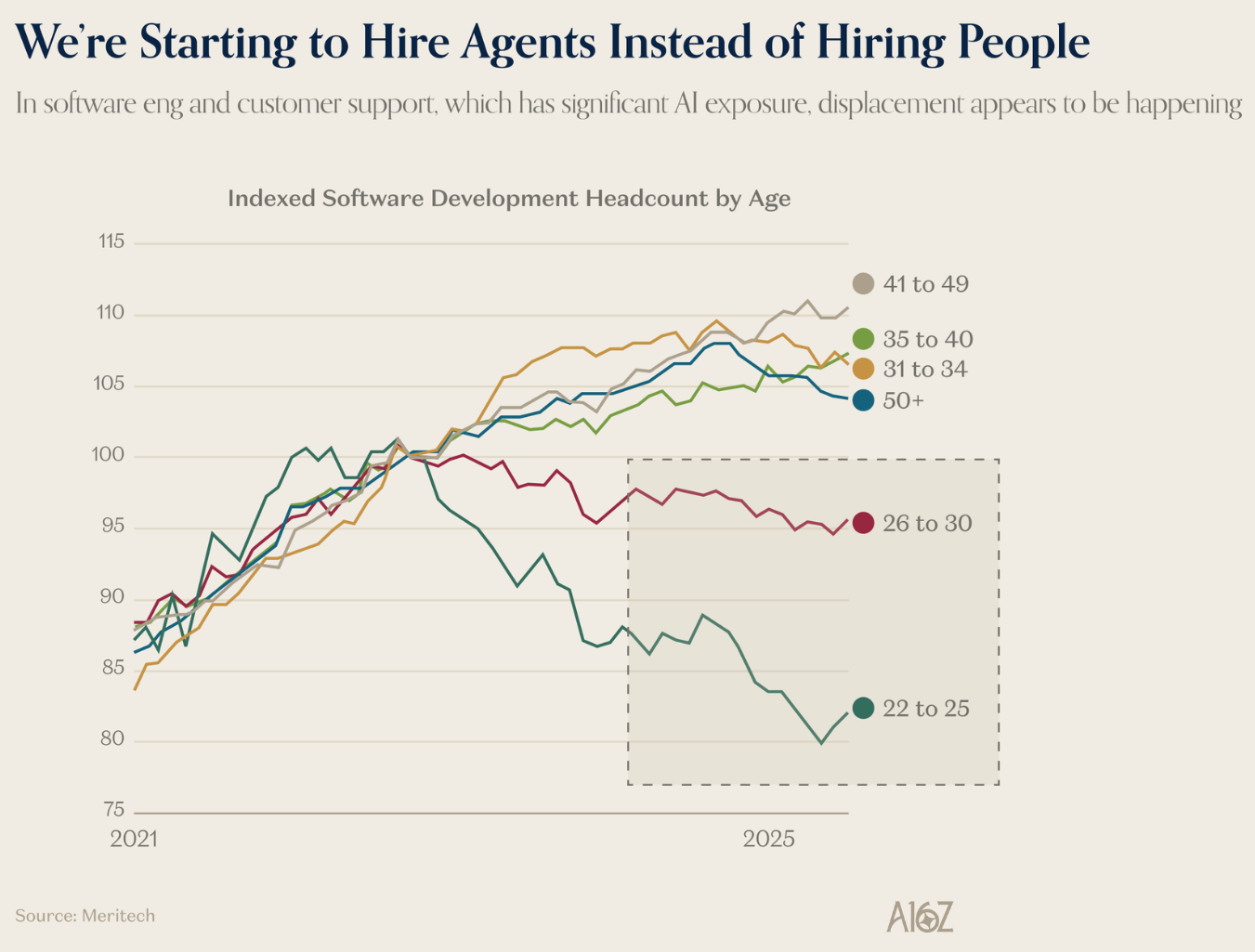
Source: a16z New Media
This trend reflects how employers are recalibrating their hiring strategies in the age of AI — for better or worse.
Entry-level roles aren’t disappearing. But they are becoming more competitive. Expectations are rising. Junior professionals are increasingly expected to:
Frame business problems clearly
Validate assumptions
Interpret outputs critically
Orchestrate AI tools effectively
In other words, the definition of “entry-level” has evolved.
What Can You Do About It?
The data job market may look daunting, but much of this is within your control.
The number one thing you should focus on is visibility. Increasing attention and getting noticed is critical, and anding a first-round interview is a major milestone today. If you’re getting callbacks, your resume and portfolio are likely in good shape.
But if you aren’t getting interviews, there may be an issue with your resume, your portfolio (or lack thereof), or how you’re positioning your skills.
And that’s exactly why I created my new course.
I recently launched a FREE course designed to help you navigate the modern data job market. Inside, you’ll learn:
Why the market feels tougher, and what employers actually want
How to build a strong personal brand and align your skills with target roles
How to craft a high-impact resume and avoid common filtering mistakes
How to stand out with GitHub projects, personal websites, and meaningful work samples
How to improve your odds through warm outreach vs. cold applications
What to expect at every stage of the hiring process, including AI-based assessments
If this resonates with you, go and enroll on Udemy today!


Whether you're feeling stuck, seeking career advancement, or unsure of your next career move, this coaching can provide clarity and direction. This coaching is designed for early to mid-career professionals, typically with less than 8 years of work experience.
Each session is hosted online via Google Meets and lasts 45 minutes. After you make a booking, I will get in touch and send a short questionnaire over so I can learn more about you and how I can help.