Star Wars The Force Awakens: Box Office Success By the Numbers

Header image by @ventiviews via Unsplash
Star Wars: The Force Awakens opened last week, and so far it’s smashing box office records left and right. It quickly snapped up the record for the biggest domestic and global opening day, weekend and week, and is on track to be the highest-grossing film of all time. For a list of all the records the movie has smashed so far, check out this article by Variety (spoiler: it’s a lot).
It’s hard to believe that The Force Awakens (TFA) has only been out for 8 days now as it has already pulled in $900 million worldwide, with half of that revenue coming from the U.S. alone. But out of the 7 installments to the Star Wars franchise, just how successful is TFA? Let’s break it down.
Figure 1 below shows the opening week (7-day total) box office sales in the U.S. for each of the seven films. I’ve only looked at U.S. performance because adjusting for inflation can be tricky when working with global figures.
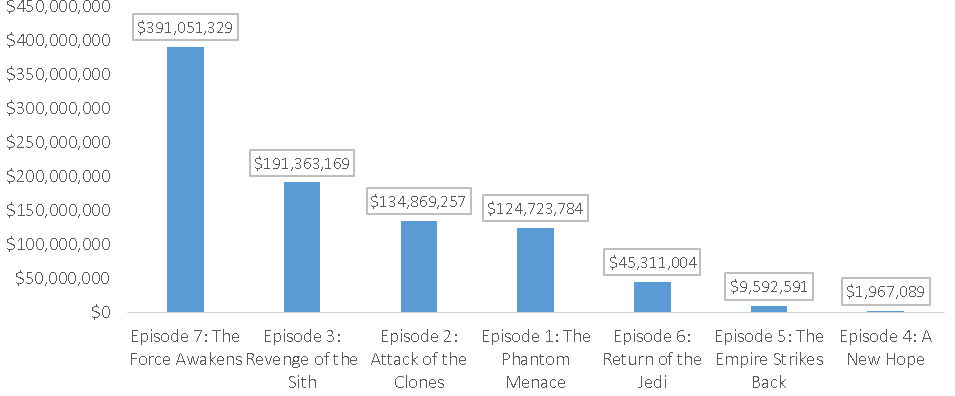
Opening Week (7 Day) Box Office Total
Below is the same chart with the totals adjusted for inflation, which I’ll use for the rest of this post. Keep in mind that we’re only looking at the total box office sales for the first 7 days from the official release. I chose to keep the time frame to just opening week for easy comparison.
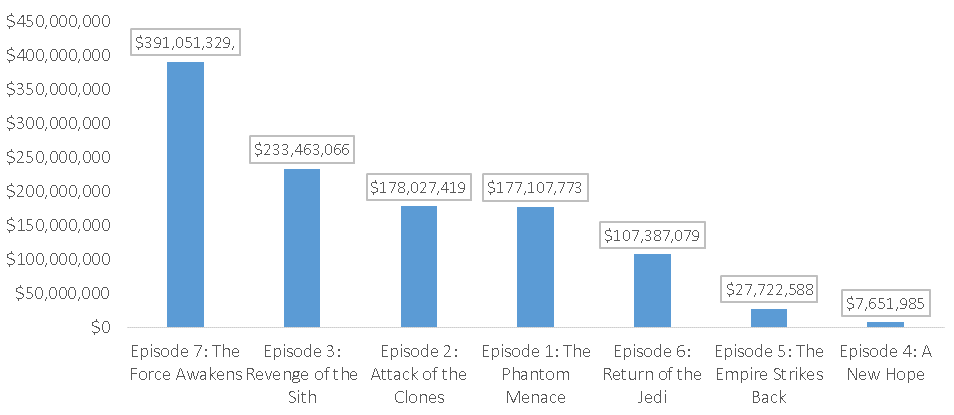
Opening Week (7 Day) Box Office Total (Adjusted for Inflation)
So yes, TFA is not only obliterating box office records, it’s the most successful Star Wars movie to date, at least in terms of sales volume. To put this into perspective, in the first 7 days, TFA made more than the first four movies combined (episodes 4, 5, 6 and 1). But does this mean that TFA is objectively the most financially successful Star Wars film? Well, there can be more than one way to define success. Box office sales volume is one way to look at it, and although I’ve adjusted for inflation for the sake of comparison, many other variables could factor into a definition of commercial success.
For example, let’s consider the scale of the theatrical release. In the United States, TFA opened to 4,134 theatres in its opening week, while A New Hope opened to just 32 (no, that’s not a typo). Keep in mind there was no existing fan base or excessive marketing push for the first Star Wars film when it was released back in 1977. And although TFA made 51 times more than A New Hope in its opening week, $7.6 million is still pretty impressive given that it ran in just 1% of the theatres.
The multi-axis chart below (Figure 3) shows the total number of theatres each of the seven films ran in during their opening week, as well as the average total sales per theatre.

Total Theatres & Box Office Sales
The chart above is interesting because it tells a slightly different story. Here you can see that the first 2 films (i.e. A New Hope and The Empire Strikes Back) accomplished a lot more with less. That is, they generated a great deal more revenue per theatre in the opening week of screening. The $200K+ per theatre by each of these films is pretty impressive, given how few cinemas they ran in (126 for Empire and 32 for New Hope). One can only imagine how long the queues were.
Another way to look at success is to consider how much revenue each film generated relative to its budget, or rather, the film’s return on investment (ROI). Below are the production budgets for each of the seven films, ordered by the year of release:
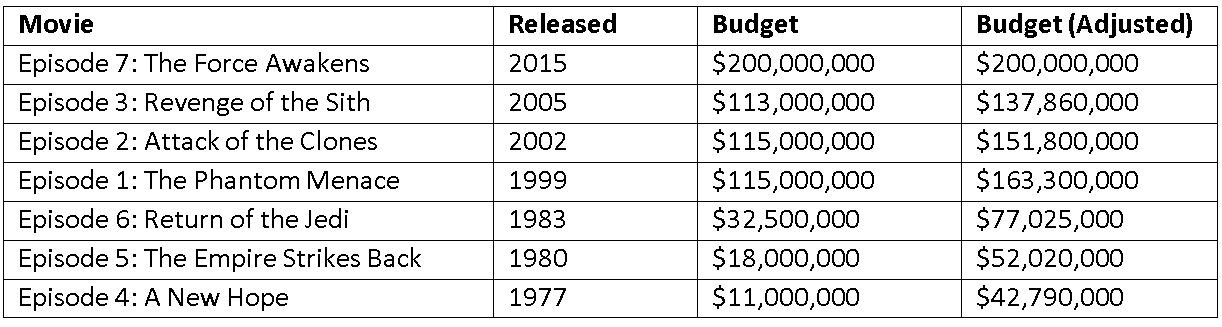
Figure 4 below shows each film’s ROI based on the production budget. Important note, I’ve used the adjusted figures for the budget and the box office sales to calculate ROI. It’s also important to remember that this chart isn’t showing ROI for the entire theatrical run. Instead, just the return for the first seven days. All seven films eventually broke even and made a profit, but this chart tells you something about the speed at which the studio made its money back.
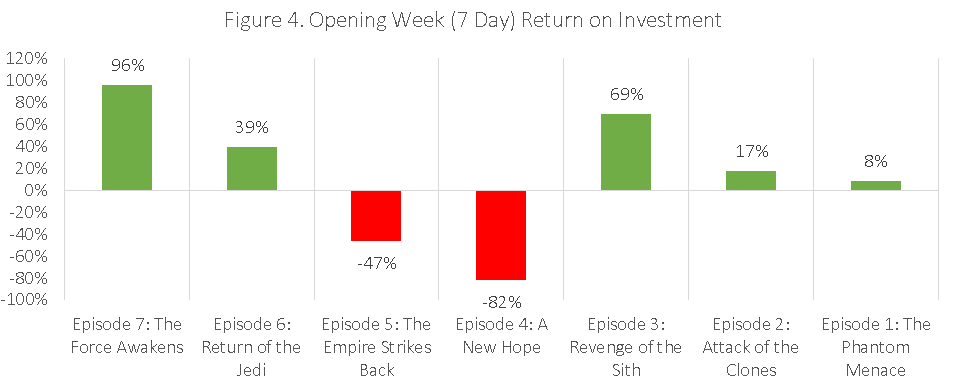
Opening Week (7 Day) Return on Investment
Here, you can see that TFA is again the winner with an ROI in its opening week of 96%, and since we’re only 8 days into the release, I think it’s safe to say that this number is going to increase significantly. So not only is TFA the highest-grossing film in the franchise, it's also the most profitable.
It’s also interesting to see that, unlike Figure 3, which shows that Episodes 4 and 5 generated the most revenue per theatre, these two films took longer to make the studio its money back as neither had broken even by day 7. However, it’s worth noting that both films went on to make a healthy profit. Box Office Mojo reports that A New Hope is the second highest-grossing domestic film of all time if you adjust for inflation (a whopping $1,485,517,400). That said, quantifying box office success for some of these films isn’t exactly straightforward. For example, although A New Hope was officially released in May of 1977, it was also re-released in theaters in 1978, 1979, 1981, 1982 and, of course, the infamous digitally remastered re-release in 1997.
It’s also important to keep in mind that there can be plenty of external factors which can affect box office success, as the world was a very different place when the first film was released. The U.S. population was 32% smaller than it is today, incomes and consumer spending were lower, and the movie industry (including the number of screens in the U.S.) was a fraction of the size.
All things considered, The Force Awakens is unambiguously the franchise’s most successful movie yet. Not only has it broken heaps of box office records in little over a week, but it’s on track to being one of the most successful movies of all time. Still, I thought it was pretty amazing to see how well some of the earlier movies performed, especially considering how much smaller their theatrical releases were compared to today.
But what’s interesting is that, despite making almost a billion dollars in a week, ticket sales aren’t even the real money maker for the franchise. Vox recently published an article where they found that A New Hope has made roughly $28 billion since its release, but only 16% of that revenue can attributed to ticket sales. The rest? Merchandise, clothes, toys, TV shows, video games, brand partnerships, licensing, royalties, the list goes on. It’s estimated that Disney will make more than $5 billion from Star Wars over the next 12 months and potentially up to $20 billion over the next five years. So, if you're thinking that The Force Awakens might be the peak of success for Disney’s run with the Star Wars franchise, you’d be dead wrong. They’re just getting started.