A Market Research Framework For Collecting Better Data

Photo by @kellysikkema via Unsplash
Whether you’re an entrepreneur looking to validate a product idea, or a product manager looking to collect customer feedback, obtaining actionable data through market research is an essential process
However, market research can be complicated. After all, the term ‘market research’ doesn’t refer to one modality, but many. From secondary research to primary, or from quant to qual, there are many different ways you can collect data to answer a business question.
But no matter which methodology (or methodologies) you’re using, you must ensure you collect your data in a structured, organised and methodical way. After all, the actions you take are only as good as the quality of the data you collect, and there are a lot of ways a research project can go wrong which can taint your and lead you astray.
In this article I’ll be sharing a research framework I developed as part of my online course, The Complete Market Research Bootcamp. This article will give you an overview of the framework. But if you want see it in action with live case studies, or you’d like to learn how to conduct various research methodologies from interviews to focus groups to surveys, then click the link below to learn more about my course.
This framework can be applied to all research methods and modalities, and is fit for any user-case, whether you’re an entrepreneur, product manager or marketing expert.
Research framework overview
Let’s start with an overview of the framework. A research project can generally be broken down into various stages and artifacts. Stages refer a set of tasks and objectives you fulfill as you progress through the research project, while artifacts are document, resources or assets that you create or produce at each stage.
In total, there are six stages, and four types of research project artifacts.
The 6 research project stages
Planning stage - At this stage you are planning your research project, which usually involve writing a research brief that outlines your core research objectives and desired outcomes. But no matter how you do it, the goal of this stage is to align on the objective of your research.
Prepare stage - You’re now preparing to collect your data, and at this stage you create or procure the necessary tools, assets, documents, or resources needed to carry out the research. For example, if you’re conducting a survey you would be designing a questionnaire at this stage. If you’re conducting interviews, you will be drafting an interview protocol.
Acquire stage - Now you’re ready to collect your data. Whether you’re conducting secondary research and scraping data from the web, or launching a survey, at this stage you will be collecting and storing data based on your research plan.
Analyze stage - After acquiring your data, you will need to organize and prepare your data for analysis. This stage can involves a wide range of tasks related to data cleaning, processing, preparation and analysis.
Interpret stage - After you have prepared and analyzed your data, the next stage will involve interpretation. This means that you’ll be translating your findings into actionable insights that your business can leverage and make decisions from.
Act stage - At this stage you will draft a plan to take action on the interpretations and findings of your research. For example, if you carried out a focus group with customers to get feedback on their buying experience, the act stage may involve briefing a product or marketing team on the feedback you collected and creating an action plan based on their specific pain points. On the other hand, if you conducted an A/B test to see which product design performed best, you would then work with your product or GTM team to bring the winning design variant to market. It’s important to note that some actions are harder than others (e.g. changing the colour of a banner on your website versus rolling out a brand new packaging for a physical product). So in some cases, the act stage might involve actually deployment, while in other cases it may be about drafting a plan to bring your recommended actions to life sometime in the future.
I find that the Act stage is sometimes neglected in research project plans, but it’s important to make sure that you’re putting your data to work and taking action. I’ve worked with clients who spent heaps of money on research, only to get stuck in ‘analysis paralysis’, or they simply failed to get buy-in from their stakeholders to fund the recommended actions identified through the research. Market research will always involve an investment, if not in money, at least in time. So you need to ensure that you’re taking action.
The 4 types of research project artifacts
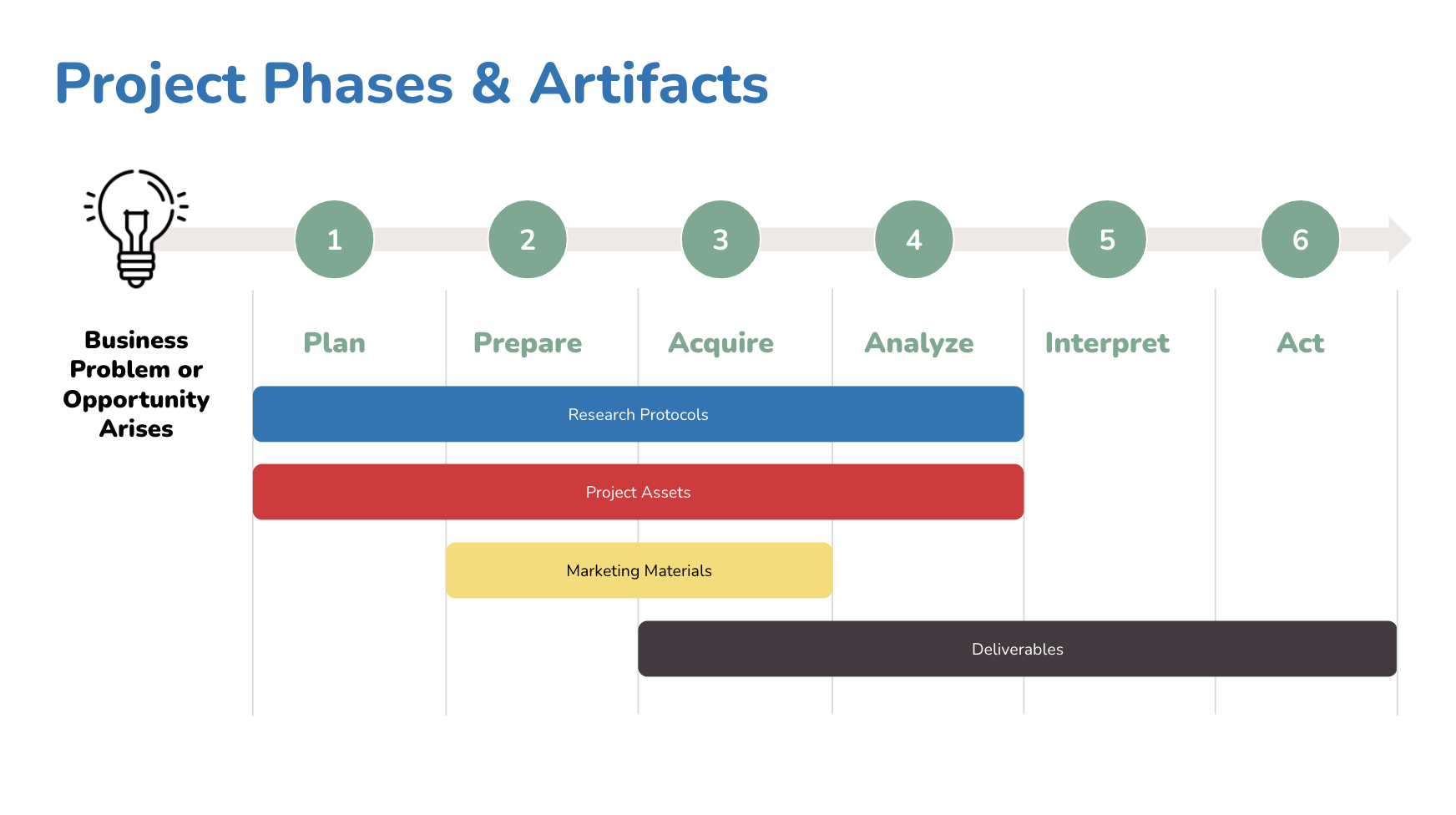
Research protocols - These are documents, or documentation, related to research procedures that must be followed. Protocols can relate to a variety of tasks, such as participant recruitment protocols, data collection protocols, and data management protocols.
Project assets - These are documents, tools or resources created or procured as a means to carry out the research project. An example can include a survey questionnaire, or even a project timeline you create to keep the project on track.
Marketing materials - This refers to marketing and communication materials that are created to communicate with participants. Examples include outreach emails or ads you create to recruit participants, reminder emails sent to survey respondents, or even post engagement communications to provide a participate more information.
Deliverables - The key data and analysis outputs of the research project, such as a raw data file or slides presentation.
Stages and artifacts
The four types of artifacts covered above tend to be more pertinent at different stages of the research project. For example. research protocols are generally only created and used between the planning and analyze stages. On the other hand, deliverables typically only kick-in once you start collecting data. For example, a raw data file from a survey (i.e. acquire stage) can be a deliverable. But that data file can then be transformed through data processing and analysis, and then be presented during the act phase.
The figure below shows which stages the various artifacts tend to be most common.
Pulling it all together
To demonstrate how all of this works, I’ve pulled together a few examples; one based on a qualitative interview, and another based on a quantitative survey.
Here’s the example for an interview.
And here’s an example based on a survey.
Conclusion
This framework is agnostic to all research types and methods, so you can apply it to any approach. The goal of using a research framework is to help guide you through your research project, from idea to execution. It will also ensure that you carry out the research in a structured and organised way, so the data you collect is valuable and impactful.
If you’re interested in learning more about this framework, how to apply it, or you want to learn about specific market research methodologies (e.g. interviews, focus groups, surveys), be sure to check out my course, The Complete Market Research Bootcamp, available on Udemy. Thanks for reading!